Truth Social gets into the fusion energy business?

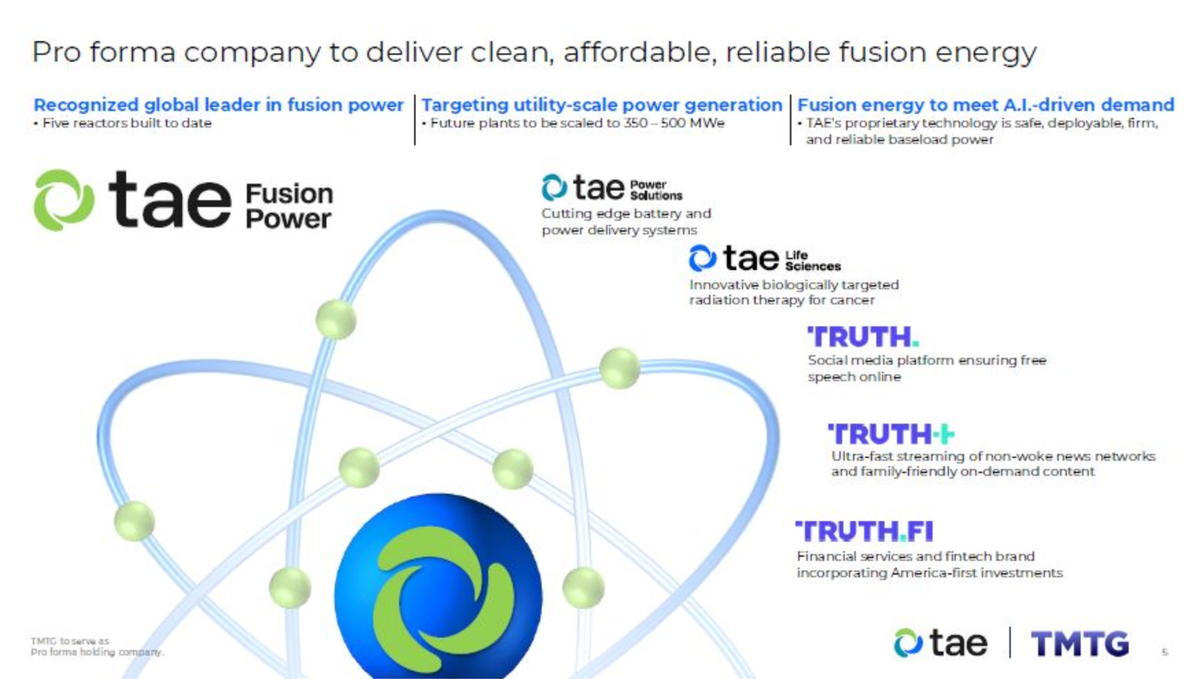
An unusual story broke this week: Donald Trump's social media company is merging with a 27-year-old business that is working on technology to generate energy using nuclear fusion. The investor presentation is – interesting?
On its face, the combination makes no sense. The two businesses work on completely different technology, aimed at completely different markets.
So what the heck?
A brief science interlude
Global climate change is real, driven by human-caused greenhouse gas emissions that trap heat in the ocean and atmosphere. In order to slow the rate of global warming, we need to decarbonize society. That means generating power using technologies that don't burn fossil fuels.
We already generate a respectable amount of power using nuclear fission. Fission reactors work by shooting neutrons – heavy sub-atomic particles – at atoms of heavy elements like uranium or plutonium. The impact splits the heavy atoms into atoms of different, lighter elements, and releases an enormous amount of energy as a side effect. The collision also releases more neutrons, which slam into other uranium or plutonium atoms, which themselves split. The result is a chain reaction that generates a steady (as long as we control it!) supply of power.
Some of the smaller atoms generated by fission are useless in continuing the reaction. They remain radioactive for a long period, requiring careful and expensive handling and storage. That's radioactive waste.
Nuclear fusion is different. Instead of breaking radioactive elements into pieces, it uses very high pressures and temperatures to force smaller atoms to combine into larger, heavier elements. That combination also releases large amounts of energy, but when carefully designed, can produce no appreciable nuclear waste products.
We don't have any man-made production fusion reactors in use today. There are some prototypes built and used sporadically for research, but creating the temperature and pressure required for fusion is finicky work. Creating those conditions today requires enormous amounts of power as input – until recently, even in carefully-controlled laboratory conditions, we had to put more energy into our fusion reactors than they produced.
There's one fusion reactor that provides almost all our power, though – the sun. It's very hot and massive, and it fuses light elements into heavier ones to create the light and heat we see and feel. In fact, green technologies like solar and wind power are just indirectly capturing that fusion energy. Photovoltaic circuits turn light into electrons we can use for power. Wind turbines spin because temperature differences across the Earth's surface cause pressure changes, moving large volumes of air. Turbines turn that rotation into electrons using magnets.
And fossil fuels are just decomposed organic matter, plants or plankton that stored up solar energy during their lives and continued to hold it after their deaths. Over geologic time periods, they were concentrated and compressed into deposits that we figured out how to extract and burn.
It was all solar energy to start, made by nuclear fusion in the sun.
I can't resist including one aside, here: Stellar nuclear fusion is what created you! Hydrogen was created in the big bang, but all the atoms of all the heavier elements – sure, helium, but also and especially carbon, iron, oxygen – were created by fusion over the enormous lifespan of the universe so far. Stars formed, burned, exploded over time, creating stellar dust that coalesced into new stars and planets, including our solar system, but now with carbon, iron and oxygen in addition to hydrogen. You are literally made of star stuff.
We know that nuclear fusion works (just gotta look up in the sky!), but we haven't learned to do it on Earth on our own behalf so far. If we could figure out how to do that, though, it would be a huge deal.
Commercial nuclear fusion
Over the past several years, scientific advances have brought us closer to producing commercially-viable power using nuclear fusion. Most importantly, we've managed to build fusion reactors that generate more energy than they consume.
There is, though, still an enormous amount of hard scientific research to do. We need to dramatically improve our margins – we need to generate much more energy from the inputs we provide, and we need to do so using safe, reliable reactors that we can build at reasonable cost. Even with those challenges before us, though, scientists are excited at the prospects and investors are optimistic enough to fund the ongoing work. I'm rooting for them!
As of this writing, Wikipedia lists 51 companies working on nuclear fusion.
TAE Technologies
TAE (company website, Wikipedia) was formed in 1998 to commercialize research by faculty members at the University of California at Irvine. It was among the earliest start-ups formed expressly to work on fusion energy and its scientific leaders have excellent pedigrees.
The company has raised $1.3Bn in invested capital to date. According to the investor presentation, the company needs additional capital to begin construction of its initial power generation facility. That project, called Da Vinci, will kick off in 2026 and, per plans, start producing power five years later.
The proposed deal would provide $200M in initial funding, with a second tranche of $100M made available when certain milestones are met. A first-of-its-kind fusion reactor facility will certainly cost more than $300M to build over five years; the deal funds site selection and some other early activity, but more funding will certainly be necessary.
So TAE needs cash now, and it needs to be able to persuade investors to provide more soon.
TMTG
The Trump Media and Technology Group (company website, Wikipedia) operates the Truth Social site. In the aftermath of the January 6, 2020 insurrection, the former President was banned from the Twitter social media site, and decided to create his own. He hired Devin Nuñes, a politician with no experience running a technology company, as CEO.
The company's most recent quarterly report shows that it had $2.6M in revenue for the first nine months of this year. It spent $143.3M over the same period, for a net loss of $140.7M so far in 2025.
I've run tech companies before; revenue that low in year five would normally lead to some tense conversations between the CEO and the board. Expenses that outstripped revenue by so much are likewise abnormal. Nuñes' pay package in 2024 was worth $47M.
Here's TMTG's stock price over the course of this year:
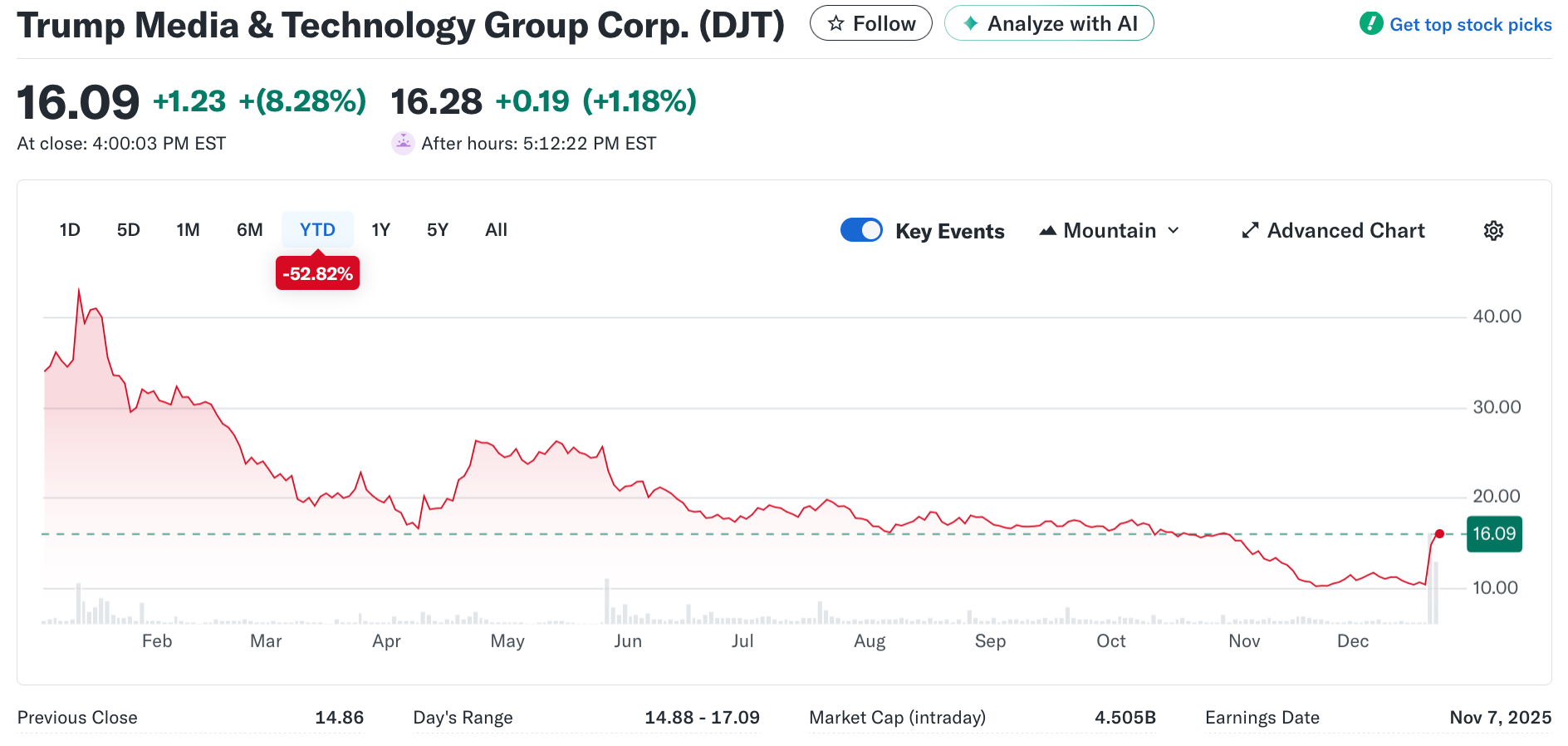
You can spot inauguration day by the spike in January. That was followed by a long and disappointing slide over the course of the year. That slide accelerated in November due to the release of the year-to-date financials, bottoming out at about $10 per share, off a peak of $43. The modest price bump near the end of the graph is the announcement of the TAE deal.
Prior to the TAE announcement, TMTG was worth about $2.8Bn in total market capitalization. In the middle of the bottom line of the Yahoo! Finance graph, you can see that the market cap of the company climbed to $4.5Bn after the deal was announced.
The deal
Let's recap:
TAE is a 27-year-old specialist that's made a lot of progress in generating energy using nuclear fusion. It can't do that yet, profitably and at scale, so there's still some risk and some science to be done. It's planning to build an expensive new generation facility, and it'll need to pay its staff for the next five years. It needs money right now, and knows it will need to raise more soon.
The Trump Media and Technology Group is bad at media and technology. Investors reacted predictably to the results announced in November – the stock price plummeted and the company's value had fallen by 77% from its peak around election day. There was enormous investor pressure on the management and board to do something.
TMTG's price spike in January didn't happen because Devin Nuñes became a better CEO that month, or because Don Jr. was suddenly a better board member, or because its software platform got better. The price spiked because Trump would make money if the company's price went up, and because Trump was in the White House. Molly White's excellent recap of Trump administration self-dealing in cryptocurrency is breathtaking, but gives the market confidence: Policy, enforcement and regulation all go better for companies that make Donald Trump money.
This is corruption, of course. The government is meant to serve the interests of all Americans, not to enrich the people who happen to hold office. But the administration and the Republican Congress simply refuse to obey those rules.
So TAE is objectively sensible in choosing to merge with TMTG. Ethics aside (a big aside!), it'll be easier to raise the money the company needs if investors think there's an inside track to government largesse. There will be policy and permitting decisions that help or hinder the company, but Don Jr.'s on the board and can just text his dad for help. It's shameful, sure, but you can understand the logic.
Why would TMTG choose TAE, though? There are all sorts of businesses looking for large capital infusions, willing to trade away significant ownership if they can just lock in the advantages of unfairly good treatment by the Trump administration.
Part of the reason, no doubt, is that that TMTG board had to move fast. Even with the President's name on the business, shareholder lawsuits get filed when the stock price falls by more than 75% in less than a year.
Besides that, though, AI is hot among investors. AI company valuations have soared:
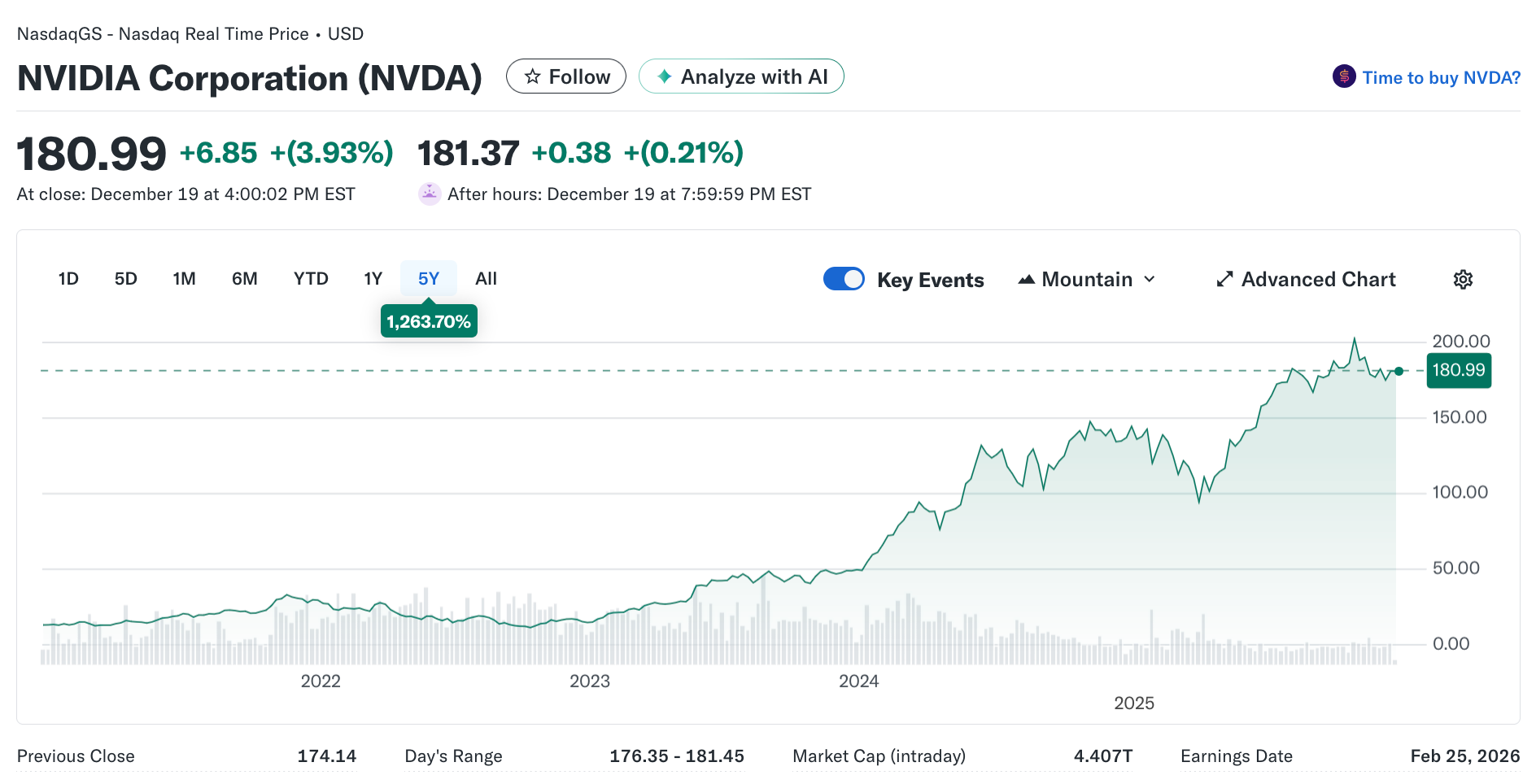
Investors bow down before 1,200% stock price appreciations and $4.4 trillion market caps. Every company raising money right now would like to rub some AI on itself so that it smells like a momentum bet.
Neither TMTG nor TAE has any particular expertise in AI. But AI companies are building lots of data centers, and those data centers will need enormous amounts of electricity to run, and the investor deck claims that the merged company will be positioned to profit from that demand:
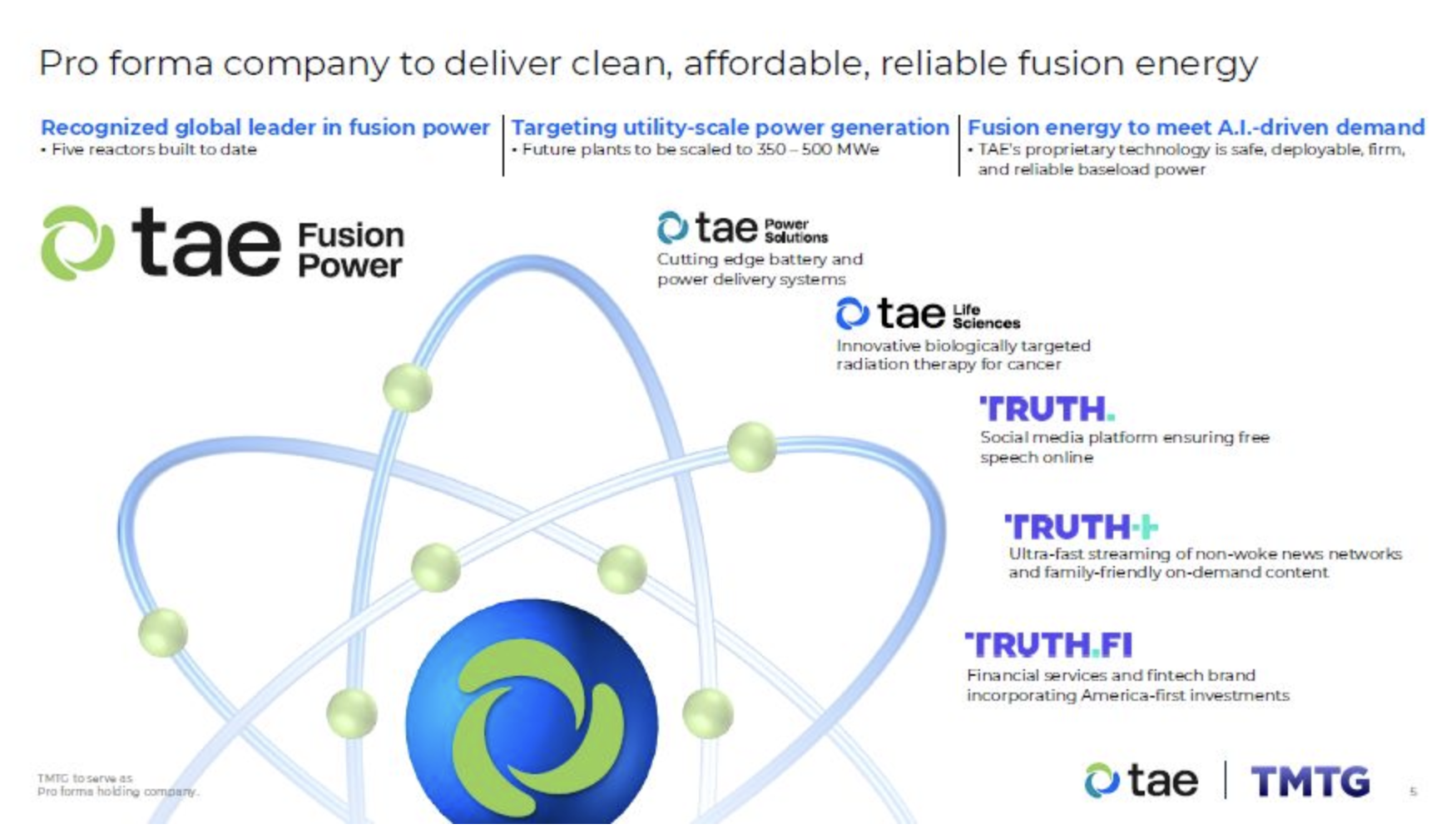
I find that slide hilarious! TAE shows up with relevant expertise and product; TMTG brings "free speech" and "non-woke" and "America-first" to the party. TAE may have chosen to dance with the devil, but it's clear who is leading and who has to follow. Don Jr. will be of no help on proton-boron versus deuterium-tritium!
For as long as the AI bubble grows, money will be available to the merged company on attractive terms. As the stock price goes up, TMTG and the Trump family can make money by selling stock.
Sure, Devin Nuñes is an abysmal failure as CEO of a media and technology company. Now he'll be co-CEO of a fusion energy company! He's likely to be at least as bad at that job. If I were a TAE board member, I'd make sure to seat him at the children's table so that he couldn't knock over anything valuable. And in case scapegoats were needed later, I'd be glad to have someone around whom I could fire at no real cost to the team doing the work.
TMTG was worth under three billion dollars just before announcing this deal. Per the terms, TMTG and TAE shareholders split the merged company down the middle, each owning half of it. The resulting company will be worth $6Bn. The TMTG board has increased the value of its equity holdings just by committing $300M to the project. In the wake of the announcement, its value climbed to $4Bn. Investors obviously believe there's future appreciation in that stock price.
TMTG flipped its failed media business into a new momentum bet. Not bad!
I'm appalled by the cynicism and lack of integrity in the TAE decision to merge. It is, though, understandable. The company has de-risked access to capital and regulators, and I bet that its executives remains in good operating control of the merged business.
I really hate this deal, though. Here's why.
Wikipedia lists 51 companies that are working on nuclear fusion. There are, no doubt, a dozen or two more that are too small or early-stage to have made the list. There are maybe one or two times that number of graduate students and faculty members doing research at universities that will be worthy of investment over the next five years. Call it a hundred or so companies, some early-stage, some later, all doing hard work on important stuff.
All those businesses ought to compete on a level playing field for investor dollars, employee talent, customers, partners and government contracts. TAE's proximity to Donald Trump immediately puts everyone else at a disadvantage.
The United States is a global economic powerhouse. We're challenged today by China, and face more market challenges from India and the emerging economies of Africa over the course of this century. We ought to be doing everything we can to maintain and improve our economic position in the world.
Russia, by contrast, and after decades of Communism and Putin kleptocracy, has an economy somewhat smaller than Italy's.
Capitalism, when it works, directs resources to the best ideas and the best operators. Russia under Putin, and now America under Trump, tilt the field in favor of the businesses of oligarchs.